
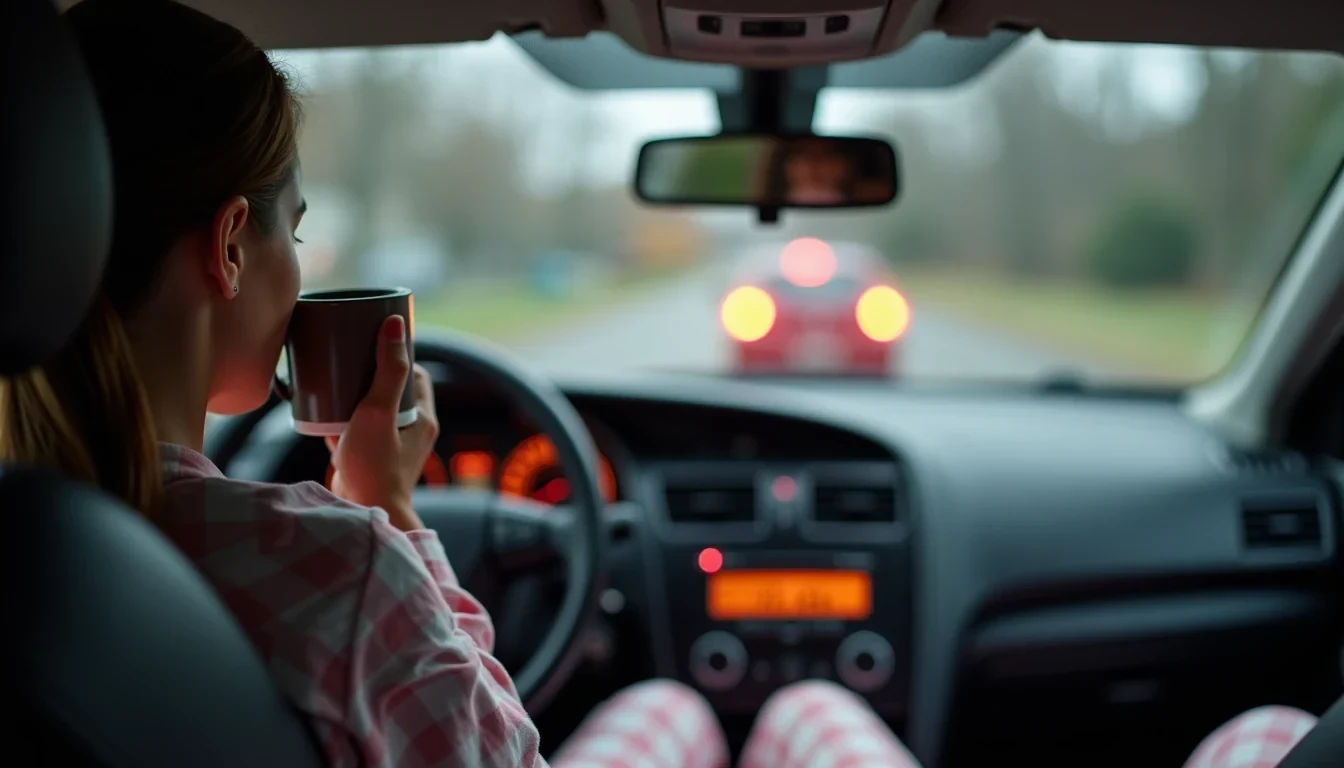
I have done the school run in pyjama pants with a coffee mug between my knees, in full makeup rushing from a meeting, and once with a chicken defrosting on the passenger seat because I forgot to take it out before I left. Every single version of me, at every time of day, has arrived at those gates wondering where the last hour went and why my petrol light is already on again.
We tell ourselves it is nothing. “It is fifteen minutes,” we say, but that estimate ignores weekday traffic at half past seven with three schools emptying onto the same stretch of road. It does not account for the child who cannot find a shoe, the forgotten reader, the queue that snakes past the robotics lab, or the second loop because someone left their lunch on the kitchen counter. Fifteen minutes is a lie we repeat because the truth is too exhausting to name.
The Sunday Morning Fallacy
My daughter’s school is genuinely fifteen minutes from my door only at eleven on a Sunday, when the robots are blinking yellow and the only other car is a Citi Golf driven by someone equally lost. We use that measurement as a fantasy to budget against.
Stats SA’s 2024 household survey found that 61.1% of learners walk to school. The rest of us use cars, taxis, buses, or some negotiated arrangement that never quite works out as planned. For those of us driving, the gap between imagined and actual time reveals the real cost. A 10 kilometre one-way trip, doubled for the return, then doubled again for the afternoon fetch, becomes 40 kilometres of stop-start driving before anyone has opened a workbook. At current petrol prices and ordinary consumption, that is roughly R77 a day in fuel alone. Over twenty school days, R1,536 disappears into the tank for the basic geography of getting children educated.
Fuel is merely the line item we notice. The car ages faster in school traffic than it would on the highway. Brake pads wear thin from constant creeping. Tyres degrade from kerb scrapes and emergency stops for children who dart between parked bakkies. A basic service every fifteen thousand kilometres arrives sooner than the calendar suggests, and each one costs two to five thousand rand. Spread that across the year and you are looking at another R160 to R400 monthly that nobody includes in the “fifteen minutes” calculation.
The Waiting Tax
Driving is only half of it. Waiting consumes time.
Morning drop-off queues at our school start forming twenty minutes before the bell. The gate procedure involves one staff member checking late slips while another argues with a parent about parking in the staff bay. I have timed it: the average wait is twelve minutes. Afternoon collection is worse. The junior primary finishes at a different time to the seniors, and the aftercare queue overlaps with the sport collection. Nobody has figured out a system that does not involve forty cars idling in a loop while children wander out in groups of one, apparently unable to recognise their own mother’s vehicle.
Then there are the activities. Netball trials run late. Choir practice was moved but the message only reached one WhatsApp group. The robotics competition ends at five but you arrived at four because last week it ended at four and you are trying to be efficient. Each of these is thirty to sixty minutes of your life you will not invoice for, will not claim back, and will not even properly account for when you wonder why you never have time to finish your own work.
The forgotten items deserve their own category: the lunchbox on the counter, the project due today that was finished last night and then left on the dining room table, the costume for the class play, the signed permission slip, the goggles for swimming. A return trip adds another twenty to thirty minutes, and it happens more often than any of us admit. I have done it with a toothbrush in my mouth. I have done it still wearing one earring from the night before.
What the Hours Actually Cost
Add it conservatively. An hour and forty minutes of actual driving on a good day. Twenty-five minutes of waiting. Another half hour for the forgotten thing, averaged across the week. Preparation and extraction time, because children do not simply teleport into vehicles; they must be located, shoed, and negotiated with. You are at two and a half to three hours daily, fifty to sixty hours a month.
That is more than a standard work week. It is unpaid and unacknowledged, performed in the gaps between whatever paid work you are trying to keep alive, or the household labour that also waits for no one.
I am not suggesting we stop. The alternatives are not simple. Walking, for the majority who do it, carries its own weight of distance and safety concerns that no parent takes lightly. Taxis and buses operate on their own schedules, with their own risks. Arranged transport, where it exists and is affordable, removes the driving but not the coordination, the waiting, or the low-grade anxiety of handing your child to someone else’s timetable.
What I am suggesting is that we stop lying about the cost. Stop saying “it is only fifteen minutes” as if that phrase has any relationship to lived experience. Stop treating the school run as a neutral background fact of parenting; it is a significant, structural demand on household resources.
The Unnamed Job
A particular fatigue comes from labor that has no name, no recognition, no boundary. The school run occupies this space perfectly. It is not housework, though it serves the household. It is not employment, though it consumes working hours. It is not childcare exactly, though it is performed for children. It is simply expected, absorbed into the invisible architecture of family life, and because everyone does it, nobody counts it.
I counted it. Not because I have a solution, but because the pretending was making me feel uniquely incompetent. The days when I could not fit in a full work block, could not finish a commission, could not meet a deadline, and could not understand where the time had gone. It had gone here: into the loop between home and school and home again, multiplied by two children, multiplied by the chaos of a system that assumes infinite parental availability.
The school run is a second job I never applied for. It has no contract, no leave days, no performance review, and certainly no salary. The least we can do is name it honestly, to ourselves and to each other, and stop measuring it against the empty road at eleven on a Sunday morning.